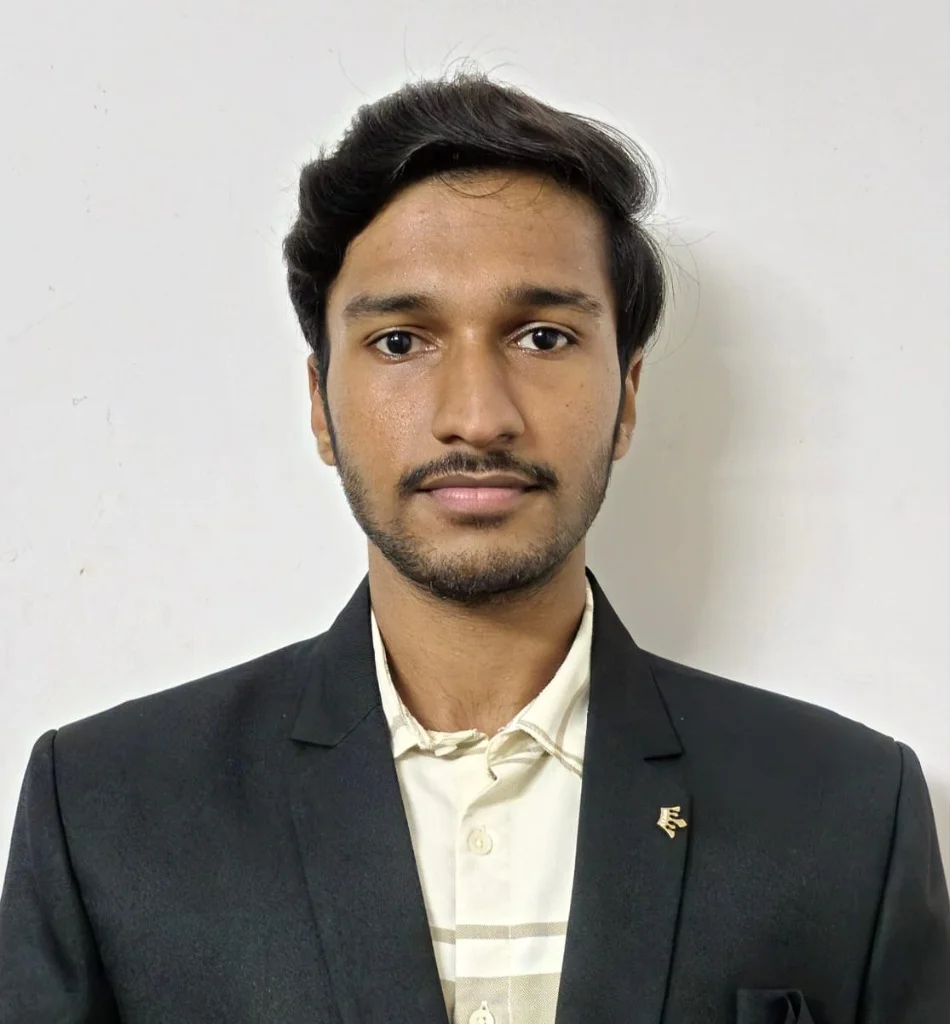
nithin.

Nithin Polavarapu’s personal corner

A little away
from the noise.

I’m Nithin. I build software, explore machine learning, and try to make complicated things a little easier.

Come see what I’m making
Nithin Polavarapu
Hello, I’m Nithin.
College projects

Things I learned by building.

Two projects exploring how models become applications people can use.

College project

Intelligent Business Analytics & Automation Suite

One Streamlit application for customer churn prediction, sentiment analysis, and image classification.

  • Customer churn prediction
  • Text sentiment analysis
  • Zero-shot image classification

Streamlit / Random Forest / DistilBERT / CLIP

Read the project story

The question

How can different kinds of business data become useful outputs in one application?

The approach

The project brings three model workflows together: Random Forest for churn prediction, DistilBERT for sentiment analysis, and CLIP for zero-shot image classification.

What was built

The documented deliverable is a unified dashboard combining predictive analytics, language, and vision.

What needs careful evaluation

Each workflow needs its own evaluation. A classification score, sentiment result, and image-label match answer different questions and should not be combined into one headline accuracy.

Current limits

A reproducible evaluation report and a breakdown of individual contributions are not published here yet.

College project

MediAI

A college project combining tabular-data models and medical-image classification across four diseases.

  • Tabular and image models
  • A shared Streamlit interface
  • Database support and PDF reports

TensorFlow / Keras / scikit-learn / Streamlit / MongoDB / SQL

An academic prototype, not a clinical diagnostic tool.

Read the project story

The question

How can several screening-model workflows share an interface while keeping their inputs and outputs distinct?

The approach

Random Forest and Logistic Regression handle diabetes and kidney-disease datasets. Convolutional neural networks handle image classification, with Streamlit connecting the workflows.

What was built

The documented application includes authentication, database support, and PDF reporting alongside its model workflows.

What needs careful evaluation

Tabular and image models need separate test sets and reports. The same patient or duplicate image should not appear in both training and evaluation data.

Current limits

This is an academic prototype, not a clinical diagnostic tool. Its results are not presented as evidence of clinical readiness.

Also built: ClearPath Germany, a study-application planning website.

An open question

What should an AI forget?

I’m exploring selective memory: deciding what an agent should keep, recall, or release as its work changes.

A concept to play with, not a trained model.

Keep what will matter again.

“I am learning machine learning.”

A lasting goal can help with the next task. Keep it while it remains relevant.

The next step is an evaluation: compare selective memory with keeping everything, and measure both useful recall and stale information.

Questions behind the work.

Two short notes on how to examine an ML project.

A model score needs context

A score is useful only when the reader knows the task, the data, and how the test was set up. Churn prediction, sentiment analysis, and image classification need separate evaluation stories.

A useful report starts with a simple baseline, describes the held-out data, and shows the mistakes as well as the overall result. It also records the code and model version needed to repeat the test.

For these college projects, publishing that evidence is the next step. The portfolio does not repeat accuracy claims without the reports behind them.

More memory is not always more useful

Old context can be relevant, redundant, or wrong. A useful memory system needs to distinguish a lasting goal from a detail that has changed.

The selective-memory question here is whether a smaller, relevant memory can support a task without carrying forward stale facts. A fair experiment would give the same tasks to no-memory, full-history, and selective-memory baselines.

Useful recall, stale-fact errors, task completion, latency, and token use would be measured separately. This is a proposed experiment; the interactive example above does not run a memory model.

A little about me.

I’m based in Vijayawada, India, working at the intersection of machine learning and product development.

I studied Computer Science with a focus on AI and ML at Parul University. My work ranges from model evaluation to the interface someone actually uses.

My college projects gave me room to explore predictive models, language, and computer vision. Selective memory is a question I’m continuing to explore.

English, Telugu, and beginner German.

Tools I work with

Python, PyTorch, TensorFlow, scikit-learn, Next.js, FastAPI, Git, MongoDB, and MySQL concepts.

The path so far

  1. Machine Learning InternCodTech IT Solutions
  2. Machine Learning InternMicro Information Technology Services
  3. B.Tech, Computer Science (AI & ML)Parul University / 7.76 CGPA
Courses & certificates

Machine Learning Specialization, Andrew Ng / Coursera (2025)

Google Prompting Essentials / Coursera (2025)

Outside work

Away from the keyboard.

Cricket, books, music, and research. A few things that belong here alongside the code.

Cricket
Always welcome in a conversation.
Books
Room for reading, beyond technical documentation.
Music
Another part of life outside software.
Research
Questions that don’t have an answer yet.

Have a book, a song, or a cricket story to share? Tell me about it.

Leave a little hello

Good conversations are welcome.

A role, a collaboration, or a question about something here. I’d be glad to hear from you.

The email link opens your email app. No form, no account.